
관리 메뉴

FireDrago
[Spring] 스프링 AOP - 포인트컷 2 본문
args
args : 인자가 주어진 타입의 인스턴스인 조인 포인트로 매칭
public class ArgsTest {

    Method helloMethod;

    @BeforeEach
    public void init() throws NoSuchMethodException {
        helloMethod = MemberServiceImpl.class.getMethod("hello", String.class);
    }

    private AspectJExpressionPointcut pointcut(String expression) {
        AspectJExpressionPointcut pointcut = new AspectJExpressionPointcut();
        pointcut.setExpression(expression);
        return pointcut;
    }

    @Test
    void args() {
        // hello(String)과 매칭
        assertThat(pointcut("args(String)")
                .matches(helloMethod, MemberServiceImpl.class)).isTrue();
        assertThat(pointcut("args(Object)")
                .matches(helloMethod, MemberServiceImpl.class)).isTrue();
        assertThat(pointcut("args()")
                .matches(helloMethod, MemberServiceImpl.class)).isTrue();
        assertThat(pointcut("args(..)")
                .matches(helloMethod, MemberServiceImpl.class)).isTrue();
        assertThat(pointcut("args(*)")
                .matches(helloMethod, MemberServiceImpl.class)).isTrue();
        assertThat(pointcut("args(String,..)")
                .matches(helloMethod, MemberServiceImpl.class)).isTrue();
    }

    /**
     * execution(* *(java.io.Serializable)): 메서드의 시그니처로 판단 (정적)
     * args(java.io.Serializable): 런타임에 전달된 인수로 판단 (동적)
     */
    @Test
    void argsVsExecution() {
        //Args
        assertThat(pointcut("args(String)")
                .matches(helloMethod, MemberServiceImpl.class)).isTrue();
        assertThat(pointcut("args(java.io.Serializable)")
                .matches(helloMethod, MemberServiceImpl.class)).isTrue();
        assertThat(pointcut("args(Object)")
                .matches(helloMethod, MemberServiceImpl.class)).isTrue();

        //Execution
        assertThat(pointcut("execution(* *(String))")
                .matches(helloMethod, MemberServiceImpl.class)).isTrue();
        assertThat(pointcut("execution(* *(java.io.Serializable))") //매칭 실패
                .matches(helloMethod, MemberServiceImpl.class)).isFalse();
        assertThat(pointcut("execution(* *(Object))") //매칭 실패
                .matches(helloMethod, MemberServiceImpl.class)).isFalse();
    }
}- 정적으로 클래스에 선언된 정보만 보고 판단하는 execution(* *(Object)) 는 매칭에 실패한다.
- 동적으로 실제 파라미터로 넘어온 객체 인스턴스로 판단하는 args(Object) 는 매칭에 성공한다. (부모 타입 허용)
@target, @within
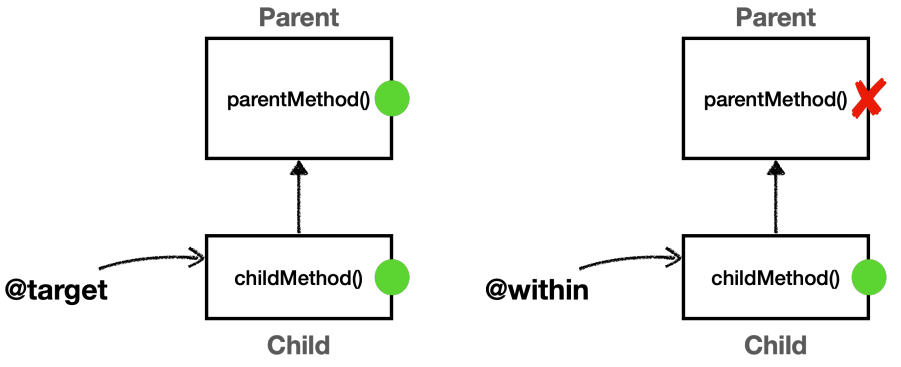
@target , @within 은 타입에 있는 애노테이션으로 AOP 적용 여부를 판단한다.
@target 은 부모 클래스의 메서드까지 어드바이스를 다 적용하고,
@within 은 자기 자신의 클래스에 정의된 메서드에만 어드바이스를 적용한다.
@Slf4j
@Import({AtTargetAtWithinTest.Config.class})
@SpringBootTest
public class AtTargetAtWithinTest {

    @Autowired
    Child child;

    @Test
    void success() {
        log.info("child Proxy={}", child.getClass());
        child.childMethod(); // 부모, 자식 모두 있는 메서드
        child.parentMethod();
    }

    static class Config {
        @Bean
        public Parent parent() {
            return new Parent();
        }
        @Bean
        public Child child() {
            return new Child();
        }
        @Bean
        public AtTargetAtWithinAspect atTargetAtWithinAspect() {
            return new AtTargetAtWithinAspect();
        }
    }

    static class Parent {
        public void parentMethod() {}
    }

    @ClassAop
    static class Child extends Parent {
        public void childMethod() {}
    }

    @Aspect
    @Slf4j
    static class AtTargetAtWithinAspect {
        // @target: 인스턴스 기준으로 모든 메서드의 조인 포인트를 선정, 부모 타입의 메서드도 적용
        @Around("execution(* hello.aop..*(..)) && " +
                "@target(hello.aop.member.annotation.ClassAop)")
        public Object atTarget(ProceedingJoinPoint joinPoint) throws Throwable {
            log.info("[@target] {}", joinPoint.getSignature());
            return joinPoint.proceed();
        }

        // @within : 선택된 클래스 내부에 있는 메서드만 조인 포인트로 선정, 부모 타입의 메서드는 적용 X
        @Around("execution(* hello.aop..*(..)) &&" +
                "@within(hello.aop.member.annotation.ClassAop)")
        public Object atWithin(ProceedingJoinPoint joinPoint) throws Throwable {
            log.info("[@within] {}", joinPoint.getSignature());
            return joinPoint.proceed();
        }
    }

}
parentMethod() 는 Parent 클래스에만 정의되어 있고,
Child 클래스에 정의되어 있지 않기 때문에 @within 에서 AOP 적용 대상이 되지 않는다.
실행결과를 보면 child.parentMethod() 를 호출 했을 때 [@within] 이 호출되지 않은 것을 확인할 수 있다.
args , @args , @target 같은 포인트컷 지시자가 있으면 스프링은 모든 스프링 빈에 AOP를 적용하려고 시도한다
이러한 표현식은 최대한 프록시 적용 대상을 축소하는 표현식과 함께 사용해야 한다.
execution(* hello.aop..*(..)) 같은 표현식을 통해 적용 대상을 줄여줘야 한다.
@annotation, @args
@annotation : 메서드가 주어진 애노테이션을 가지고 있는 조인 포인트를 매칭
@annotation(hello.aop.member.annotation.MethodAop)@Slf4j
@SpringBootTest
@Import(AtAnnotationTest.AtAnnotationAspect.class)
public class AtAnnotationTest {
@Autowired
MemberService memberService;
@Test
void success() {
log.info("memberService Proxy={}", memberService.getClass());
memberService.hello("helloA");
}
@Aspect
static class AtAnnotationAspect {
@Around("@annotation(hello.aop.member.annotation.MethodAop)")
public Object doAtoAnnotation(ProceedingJoinPoint joinPoint) throws Throwable {
log.info("[@annotation] {}", joinPoint.getSignature());
return joinPoint.proceed();
}
}
}
@args : 전달된 실제 인수의 런타임 타입이 주어진 타입의 애노테이션을 갖는 조인 포인트
매개변수 전달
포인트컷 표현식을 사용해서 어드바이스에 매개변수를 전달할 수 있다.
1. 포인트컷의 이름과 매개변수의 이름을 맞추어야 한다.
2. 타입이 메서드에 지정한 타입으로 제한된다.
@Slf4j
@Import(ParameterTest.ParameterAspect.class)
@SpringBootTest
public class ParameterTest {


    @Autowired
    MemberService memberService;

    @Test
    void success() {
        log.info("memberService Proxy={}", memberService.getClass());
        memberService.hello("helloA");
    }

    @Slf4j
    @Aspect
    static class ParameterAspect {

        @Pointcut("execution(* hello.aop.member..*.*(..))")
        private void allMember() {}

        // 파라미터로 받아 올 수 있다.
        @Around("allMember() && args(arg,..)")
        public Object logArgs2(ProceedingJoinPoint joinPoint, Object arg)
                throws Throwable {
            log.info("[logArgs2]{}, arg={}", joinPoint.getSignature(), arg);
            return joinPoint.proceed();
        }

        @Before("allMember() && args(arg,..)")
        public void logArgs3(String arg) {
            log.info("[logArgs3] arg={}", arg);
        }

        @Before("allMember() && this(obj)")
        public void thisArgs(JoinPoint joinPoint, MemberService obj) {
            log.info("[this]{}, obj={}", joinPoint.getSignature(), obj.getClass());
        }

        @Before("allMember() && target(obj)")
        public void targetArgs(JoinPoint joinPoint, MemberService obj) {
            log.info("[target]{}, obj={}", joinPoint.getSignature(), obj.getClass());
        }

        @Before("allMember() && @target(annotation)")
        public void atTarget(JoinPoint joinPoint, ClassAop annotation) {
            log.info("[@target]{}, obj={}",
                    joinPoint.getSignature(), annotation);
        }

        @Before("allMember() && @within(annotation)")
        public void atWithin(JoinPoint joinPoint, ClassAop annotation) {
            log.info("[@within]{}, obj={}",
                    joinPoint.getSignature(), annotation);
        }

        @Before("allMember() && @annotation(annotation)")
        public void atAnnotation(JoinPoint joinPoint, MethodAop annotation) {
            log.info("[@annotation]{}, annotationValue={}",
                    joinPoint.getSignature(), annotation.value());
        }
    }
}
- logArgs2 : args(arg,..) 와 같이 매개변수를 전달 받는다.
- logArgs3 : @Before 를 사용한 축약 버전이다. 추가로 타입을 String 으로 제한했다.
- this : 프록시 객체를 전달 받는다.
- target : 실제 대상 객체를 전달 받는다.
- @target , @within : 타입의 애노테이션을 전달 받는다.
- @annotation : 메서드의 애노테이션을 전달 받는다. 여기서는 annotation.value() 로 해당 애노테이션의 값을 출력하는 모습을 확인할 수 있다.
this, target
'프로그래밍 > Spring' 카테고리의 다른 글
| [Spring] @ModelAttribute 바인딩 null 문제 (0) | 2024.05.26 |
|---|---|
| [Spring] 스프링 AOP - 실무 주의사항 (0) | 2024.05.22 |
| [Spring] 스프링 AOP - 포인트컷 1 (0) | 2024.05.20 |
| [Spring] 스프링 AOP 구현 (0) | 2024.05.18 |
| [Spring] 스프링 AOP 개념 (0) | 2024.05.17 |
'프로그래밍/Spring' Related Articles
more


